
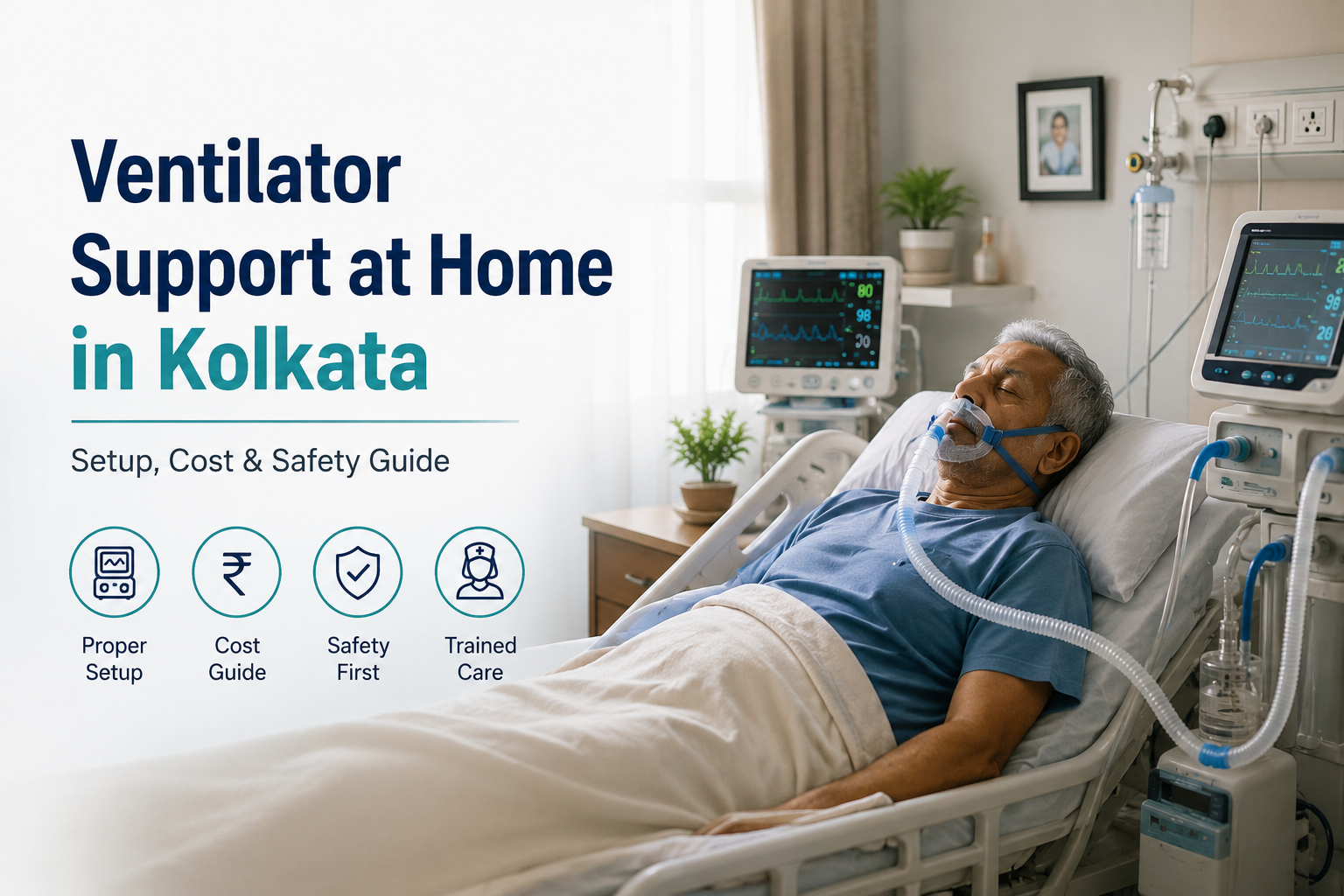
When a patient is discharged from the hospital but still needs breathing support, continuous monitoring, or intensive nursing care, families often face an important question: Can ICU care continue safely at home?
For some patients, the answer can be yes. With the right medical equipment, trained healthcare professionals, proper monitoring, and a clear emergency plan, ventilator support at home in Kolkata can help suitable patients continue their care in a familiar environment.
A properly planned ICU setup at home in Kolkata may include a ventilator, oxygen support, ICU bed, patient monitor, suction machine, infusion pumps and trained nursing support. However, home critical care should always be planned according to the patient’s medical condition and the treating doctor’s advice.
This guide explains how a home ICU works, what equipment may be needed, the possible cost, and the most important safety precautions families should understand.
What Is Ventilator Support at Home?
Ventilator support at home means using a medical ventilator to help a patient breathe when their lungs or breathing muscles are not able to provide enough support on their own.
Depending on the patient’s condition, the doctor may recommend:
- Non-invasive ventilation such as BiPAP
- CPAP support for selected conditions
- Invasive ventilation through a tracheostomy tube
- Oxygen therapy along with respiratory support
- Regular monitoring of oxygen level and other vital signs
Home ventilation is not simply a matter of bringing a ventilator into the bedroom. The machine needs to be prescribed and configured according to the patient’s medical requirements.
The patient may also need trained nursing support to monitor breathing, manage secretions, administer medicines, maintain the airway and respond to changes in condition.
Who May Need ICU or Ventilator Care at Home?
Not every patient who has been in an ICU needs a home ICU. Home critical care is generally considered when a patient is medically stable enough to leave the hospital but still requires significant medical support.
Some patients who may be considered for critical care at home include:
- Patients who remain dependent on a ventilator after hospital treatment
- Patients recovering from serious respiratory illnesses
- Patients with certain neurological conditions affecting breathing
- Patients requiring tracheostomy care
- Patients needing regular suctioning because they cannot clear secretions properly
- Patients who require continuous monitoring of vital signs
- Patients recovering after major surgery or prolonged hospitalisation
- Bedridden patients who require intensive nursing and medical support
The decision should be made by the treating doctor after reviewing the patient’s condition.
If a patient is unstable or requires emergency treatment that cannot be safely provided at home, hospital care is the safer option.
Step-by-Step Home ICU Setup Process
Setting up an ICU at home should be planned before the patient arrives home whenever possible.
1. Medical Assessment
The first step is understanding exactly what the patient needs.
The treating doctor may determine:
- Whether ventilator support is required
- Which type of respiratory support is appropriate
- Oxygen requirements
- Monitoring requirements
- Medication and infusion needs
- Suction requirements
- Nursing hours required
- Whether tracheostomy or airway care is needed
This assessment helps prevent unnecessary equipment from being rented.
2. Choose a Suitable Room
A clean, well-ventilated room with enough space around the bed is usually preferred.
The room should have:
- Easy access for nurses and caregivers
- Sufficient electrical outlets
- Space for medical equipment
- Good lighting
- Easy access for emergency personnel
- Adequate ventilation
- A clear path for moving the patient if an emergency transfer is required
The equipment should not block doors, windows or emergency pathways.
3. Arrange the ICU Equipment
The equipment should be selected according to the patient’s prescription and care plan.
Depending on the patient, this can include a ventilator, oxygen equipment, ICU bed, multiparameter monitor, suction machine, infusion pumps and other medical devices.
4. Install and Test the Equipment
Medical equipment should be installed and checked before the patient returns home.
The ventilator, oxygen supply, monitor, suction machine and other equipment should be tested properly.
Power backup is particularly important for patients who depend on electrically powered life-support equipment.
5. Arrange Trained Nursing Support
A ventilator-dependent patient may need specialised nursing care rather than only a general caregiver.
The nursing team should understand:
- Ventilator operation
- Airway and tracheostomy care
- Suction procedures
- Oxygen safety
- Monitoring vital signs
- Medication administration
- Infection prevention
- Recognising warning signs
- Emergency escalation procedures
6. Create an Emergency Plan
Before starting home ICU care, the family should know what to do if the patient’s condition suddenly changes.
The emergency plan should clearly identify:
- Who should be contacted first
- Where the patient should be transferred if hospitalisation becomes necessary
- How emergency transport will be arranged
- What backup oxygen is available
- What to do during a power failure
- What to do if the ventilator stops working
A home ICU should never operate without an emergency backup plan.
Equipment Required for Home Ventilator and ICU Setup
The exact equipment depends on the patient’s condition. A typical setup may include some or all of the following.
1. Home Ventilator
A ventilator supports breathing when the patient cannot breathe adequately without assistance.
The machine must be selected and configured according to the doctor’s prescription.
2. Oxygen Concentrator
An oxygen concentrator can provide supplemental oxygen for patients who have been prescribed oxygen therapy.
Some patients may also require an oxygen cylinder as a backup.
3. ICU or Electric Hospital Bed
An adjustable ICU bed makes positioning easier and can improve comfort and safety for bedridden patients.
Side rails may also help reduce the risk of accidental falls.
4. Multiparameter Patient Monitor
A patient monitor may be used to track important vital signs such as:
- Oxygen saturation
- Heart rate
- Blood pressure
- Respiratory rate
- Temperature
The exact parameters required depend on the patient’s condition.
5. Suction Machine
A suction machine may be necessary for patients who cannot clear saliva or respiratory secretions effectively.
This can be particularly important for some tracheostomy and ventilator-dependent patients.
6. Infusion or Syringe Pump
Some patients may require controlled administration of medicines or fluids through an infusion or syringe pump.
These devices should be operated by trained medical professionals.
7. Air Mattress
Patients who remain in bed for long periods may be at risk of pressure sores.
An appropriate pressure-relieving mattress can form part of a complete home ICU setup.
8. Nebulizer
A nebulizer may be prescribed for certain respiratory treatments.
It should only be used according to the patient’s medical treatment plan.
9. Backup Power
Power failure can be a serious concern for patients who depend on ventilators or other electrical medical equipment.
A suitable backup arrangement should be planned before the patient comes home.
Home Ventilator Safety: Important Rules for Families
Home ventilator safety should always be treated as a priority.
Families should never attempt to change ventilator settings without medical instructions.
Keep the Ventilator Connected Properly
The breathing circuit, tubing and connections should be checked regularly according to the care team’s instructions.
Loose or disconnected tubing can affect ventilation.
Keep Backup Oxygen Available When Prescribed
If the patient depends on oxygen, the family should understand the backup oxygen arrangement and know how to access it during equipment or power problems.
Check the Power Supply
The ventilator should be connected to a safe electrical supply.
A backup power solution should be available for patients who cannot safely remain without ventilation.
Monitor the Patient, Not Just the Machine
A ventilator display provides important information, but the patient’s condition is equally important.
Changes such as unusual breathing difficulty, worsening drowsiness, bluish lips or skin, sudden confusion, or a significant change in oxygen saturation require immediate medical attention.
Maintain Good Hygiene
Hands should be cleaned before handling the patient, airway equipment or ventilator components.
Equipment should be cleaned and maintained according to the manufacturer’s instructions and the healthcare team’s guidance.
Keep the Area Smoke-Free
Smoking, incense, open flames and other fire hazards should be kept away from oxygen equipment.
Oxygen supports combustion, making fire safety extremely important.
Keep Emergency Numbers Easily Available
The family should have the contact details of the doctor, nursing team, equipment provider and emergency transport service in an easily accessible location.
How Much Does a Home ICU Cost in Kolkata?
The home ICU cost in Kolkata can vary significantly because every patient requires a different level of care.
There is no single fixed price for ICU setup at home.
The total cost may depend on:
- Type of ventilator required
- Oxygen requirement
- ICU bed rental
- Patient monitoring equipment
- Suction machine
- Infusion or syringe pumps
- Air mattress
- Number of nursing hours
- Doctor visits or supervision
- Duration of care
- Consumables and medical supplies
- Equipment maintenance and technical support
- Emergency support requirements
Indicative Cost Structure
Families can think of the total expense in several parts:
Equipment rental:
Ventilator, ICU bed, monitor, oxygen equipment, suction machine and other equipment may be charged separately or as part of a package.
Nursing care:
The cost depends on whether the patient requires 12-hour nursing, 24-hour nursing or specialised critical-care support.
Doctor supervision:
Some patients may require regular doctor visits or remote medical supervision.
Consumables:
Tubing, masks, catheters, dressings, gloves and other supplies may create additional expenses.
Emergency and backup arrangements:
Patients with complex medical needs may require additional backup equipment or support.
Because requirements are different for every patient, families should ask for an itemised home ICU cost estimate in Kolkata before starting care.
The most important factor should not be choosing the cheapest setup. The equipment, nursing support and emergency arrangements must be appropriate for the patient’s medical condition.
Benefits of ICU Care at Home
For the right patient, critical care at home can offer several practical and emotional benefits.
Familiar Environment
Being at home can be more comfortable for patients who have already spent a long time in the hospital.
Family Presence
Family members can remain close to the patient and participate in daily care under professional guidance.
Personalised Attention
A home care team can focus closely on one patient rather than caring for multiple patients in a hospital ward.
Reduced Travel
Families do not have to repeatedly travel to the hospital for routine care that can safely be managed at home.
Potentially Lower Long-Term Cost
For some medically stable patients requiring long-term support, home care may cost less than prolonged hospitalisation. The actual cost depends on the patient’s equipment and nursing requirements.
Greater Comfort
A familiar room, familiar people and a quieter environment can make long-term care easier for some patients and families.
However, home ICU care should not be viewed as a replacement for hospital treatment in every situation.
Home ICU vs Hospital ICU: Which Is Better?
The answer depends on the patient’s medical condition.
| Home ICU | Hospital ICU |
|---|---|
| Patient remains in a familiar environment | Patient remains in a medical facility |
| Personalised bedside care may be possible | Access to a full hospital team |
| Suitable for selected stable patients | Suitable for unstable or highly critical patients |
| Family can remain close | Hospital-based monitoring and emergency facilities |
| Equipment is brought into the home | Full hospital infrastructure is available |
| Requires strong emergency backup planning | Emergency response is immediately available within the hospital |
A home ICU can be a practical option for a medically stable patient who has been assessed as suitable for home care.
A hospital ICU remains necessary when the patient needs complex emergency treatment, advanced procedures or continuous hospital-level intervention that cannot safely be provided at home.
When Should You Choose a Hospital Instead of Home Care?
Home care is not appropriate simply because the family prefers to avoid the hospital.
Seek immediate medical help if the patient develops serious symptoms such as:
- Severe or rapidly worsening breathing difficulty
- Persistent low oxygen levels despite prescribed support
- Sudden loss of consciousness
- New severe confusion
- Blue or grey lips or skin
- Severe chest pain
- Uncontrolled bleeding
- Repeated seizures
- Sudden major changes in blood pressure or heart rate
- Ventilator failure that cannot be safely resolved
- Any emergency situation that the home care team cannot manage
If you are unsure whether the patient is stable enough for home care, speak with the treating doctor or critical-care team before making the transfer.
Questions to Ask Before Arranging ICU Setup at Home in Kolkata
Before choosing a home ICU service, families should ask:
- What equipment does the patient actually require?
- Is a ventilator necessary, and what type has been prescribed?
- Will trained critical-care nurses be available?
- Is doctor supervision available when required?
- What happens during a power failure?
- Is backup oxygen available when prescribed?
- What happens if the ventilator develops a technical problem?
- How frequently will the equipment be checked and maintained?
- What is included in the quoted price?
- Which costs are charged separately?
- Is emergency hospital transfer support available?
- Can the setup be arranged before the patient is discharged?
Getting clear answers to these questions can help families avoid confusion during an already stressful time.
Why Proper Planning Matters in Home Critical Care
A home ICU is more than a hospital bed and a few machines.
Safe ICU setup at home in Kolkata requires coordination between the doctor, nursing team, equipment provider and family.
The room must be prepared. Medical equipment must be appropriate and tested. Ventilator settings must follow medical instructions. Nurses must understand the patient’s condition. Backup oxygen and power arrangements should be considered. Most importantly, there must be a clear plan for what happens if the patient’s condition becomes worse.
Good planning can make home care safer and more manageable for everyone involved.
Conclusion: Safe Ventilator Support at Home Starts With the Right Plan
Moving a ventilator-dependent or critically ill patient from hospital to home can feel overwhelming. Families often worry about the equipment, nursing care, cost and what they should do if something goes wrong.
The good news is that ventilator support at home in Kolkata can be considered for suitable patients when it is carefully planned and medically supervised.
A complete home ICU setup may include a ventilator, oxygen support, ICU bed, patient monitor, suction machine, infusion pumps, pressure-relieving mattress and trained nursing care, depending on the patient’s needs.
The right setup is different for every patient. Before arranging critical care at home, discuss the plan with the treating doctor and make sure the home has the required equipment, trained support, backup arrangements and emergency plan.
For families considering ICU setup at home in Kolkata, home ventilator support, or critical care at home, the first step is to understand the patient’s exact medical requirements. Once those needs are clear, the home care setup can be planned around the patient’s safety, comfort and ongoing medical needs.
Frequently Asked Questions About Ventilator Support at Home in Kolkata
Can a ventilator patient be cared for at home?
Yes, some medically stable ventilator-dependent patients can receive care at home. However, suitability must be assessed by the treating medical team.
How much does ICU setup at home cost in Kolkata?
The cost varies according to the equipment, ventilator requirements, nursing hours, doctor supervision, duration of care and other medical needs. An individual assessment is the best way to get an accurate estimate.
What equipment is needed for a home ICU?
Depending on the patient, equipment may include a ventilator, oxygen supply, ICU bed, patient monitor, suction machine, infusion pumps, air mattress and nebulizer.
Is home ventilator care safe?
Home ventilator care can be appropriate for selected patients when the ventilator is prescribed and managed correctly, trained professionals are involved, equipment is maintained properly and an emergency plan is available.
Does every ventilator patient need 24-hour nursing?
Not necessarily. The required level of nursing depends on the patient’s condition, type of ventilation, airway needs, medication requirements and doctor’s recommendations.
Can ICU care be arranged at home after hospital discharge?
Yes, home ICU care may be arranged for patients who are medically suitable for discharge but still require intensive monitoring, respiratory support or specialised nursing care. Planning the setup before discharge can make the transition smoother.
What should I do if a home ventilator patient suddenly becomes worse?
Follow the patient’s emergency care plan and seek immediate medical assistance. Serious breathing difficulty, loss of consciousness, severe oxygen desaturation, blue lips or other sudden deterioration should be treated as an emergency.
No responses yet